While it’s possible ( and tempting ) to dismiss the work of Thomas Pynchon as nothing more than the masturbatory impulse to flex one’s intellectual muscles for all the world to see, I take a different view. My contention is that the cacophony of information that Pynchon presents in his novels ( some of which is real and very well researched, some of which is mythology perverted to fit reality so closely it looks like the real skin, some of which is simply whimsical nonsense ) is actually a carefully crafted conceptual illusion that encapsulates the fractal madness at the heart of Postmodernism in a way that no Foucault or Baudrillard academic treaties could ever even aspire to.
The best example I can point to is the 1997 novel, Mason & Dixon. Not because it is the most illustrative of this interpretation, but because it is the one I fixated on the most and spent over a year making an interactive digital art piece about.
Mason & Dixon is the highly fictionalized and absurd account of the mapping of the Mason-Dixon line by Charles Mason and Jeremiah Dixon in the 16th century. The novel as a whole is whirlwind of animatronic dogs that speak perfect English, vast landscapes with roaming Golem, and the realization of feng shui prophecy on a global scale. That said, this book is also remarkably historically accurate.
You can find digital copies of M&D’s handwritten fieldnotes and it is clear that Pynchon used these notes to map out his novel. As you read the novel you can find specific locations and events that are described to a T in the actual fieldnotes. Even the chronology ( both in space and time ) in the novel perfectly mirrors what is described in the notes. This allows for a very interesting possibility: if you were to read close enough and to do enough research you could make a realistic and wholly “accurate” map of the novel and superimpose it over the “real” map of their actual movements.
While this may sound like a frivolous pursuit ( and, in many ways, it is ) it does allow one to create a “tangible” representation of one of the foundational principals of Postmodernism: the distrust of meta-narratives ( Stanford Encyclopedia of Philosophy )
What are metanarratives? They are the society-level narratives that we are born into and are thus irreparably shaped by even as their exact shape or meaning is wholly mutable and indistinct. A classic example is the bible. When a person that believes is asked about “the bible” they have a very defined idea of what that is. They see it as an immutable tome whose “truth” is undoubted and consistent. The truth is that the bible, from its origin to its innumerable revisions and modifications, has never existed as singular “thing”. From it’s inception, the bible has always been a hodgepodge of texts written by different ( and sometime contradictory ) authors that were sometimes not even alive during the original events or when other parts of the book were written. This book has then subsequently been subjected to council after council, translation after translation, and interpretation after interpretation. It is a diaspora of meaning that results in billions of people being able to point to the “same thing” as the backing of their nerrative even if that “thing” differs from person to person. While I use the example of the bible it must be noted that metanarratives are not by nature religious. They take the form of political paradigms, societally ingrained bigotries, and even unsubstantiated scientific foundations ( although I do believe that there can exist a level of objectivity in the scientific process and mathematical theorems that can put them in a unique category of their own [ but that’s a whole other topic ] ).
A very large part of Postmodernism is making disinterested analysis of these metanarratives inside a historical, societal, and sociological context and showing the inherent contradictions and limitations therein. What does this have to do with Mason & Dixon? Think of it as if the handwritten fieldnotes from M&D are the “original text” of a metanarrative. In many ways, these notes are a much more of an objective archive than many foundational religious and philosophical texts. We know the authors, we have exact days for every entry, we can cross-reference external sources to confirm specific information, we even have exact longitudes and latitudes that can be confirmed by artifacts. Pynchon then takes these extremely detailed notes and extrapolates a wild, unbelievable story that, at many points, lifts its heels off the ground of reality and take flights through metaphor and myth. But still, the underpinning structure of the narrative is built upon those fieldnotes. Notes that should be “true” and immutable. But the deeper you dig into each nuance you start to see where the logic breakdown. Not the logic of the story, but the logic of the supposedly “true” fieldnotes. As you look into every tiny detail you start to notice how parts of it make no sense. Gaps in time that grasp at you with their inexplicability, inhuman reactions that feel more like justifications than explanations, little moments of guarded language that make you certain that something important was left unsaid.
My point is that what Pynchon achieves is to – in real time – create a metanarrative, a nerrative, and its utter contradiction in the same breathless hollow. The novel is detailed enough that I was – at times – able to track down the exact pub where M&D likely stopped to drink on an unimportant date in the 17-hunderds. It is also detailed enough to make you realize the impossible gaps in time and space that exist in the original fieldnotes. The brilliant trick of this novel is that the more you look into it the less sure you are about the validity of any of it, even the moments that can be traced directly to their original source. It creates a vast claustrophobia where you are left wheezing and gasping trying to hold on to anything that holds any objectivity.
Mason & Dixon art project for “Pynchon In Public” 2017
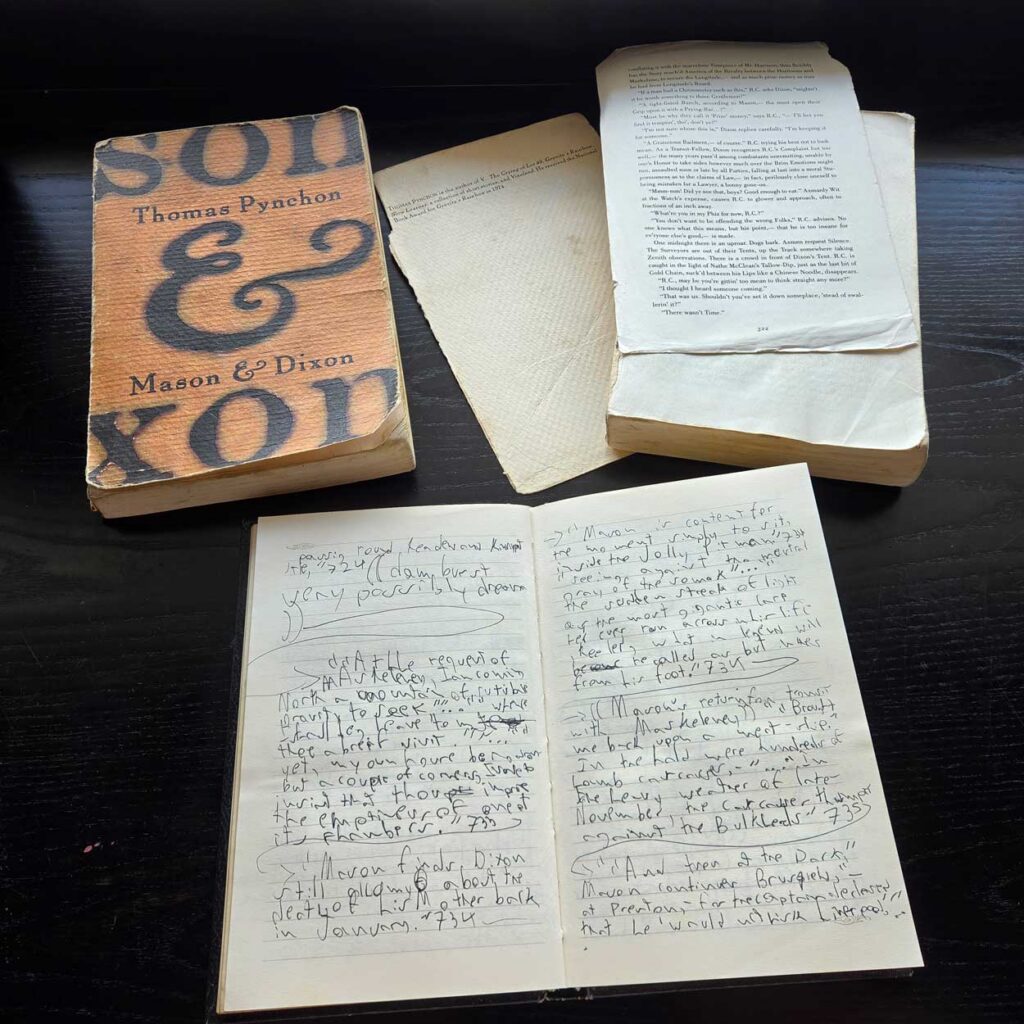
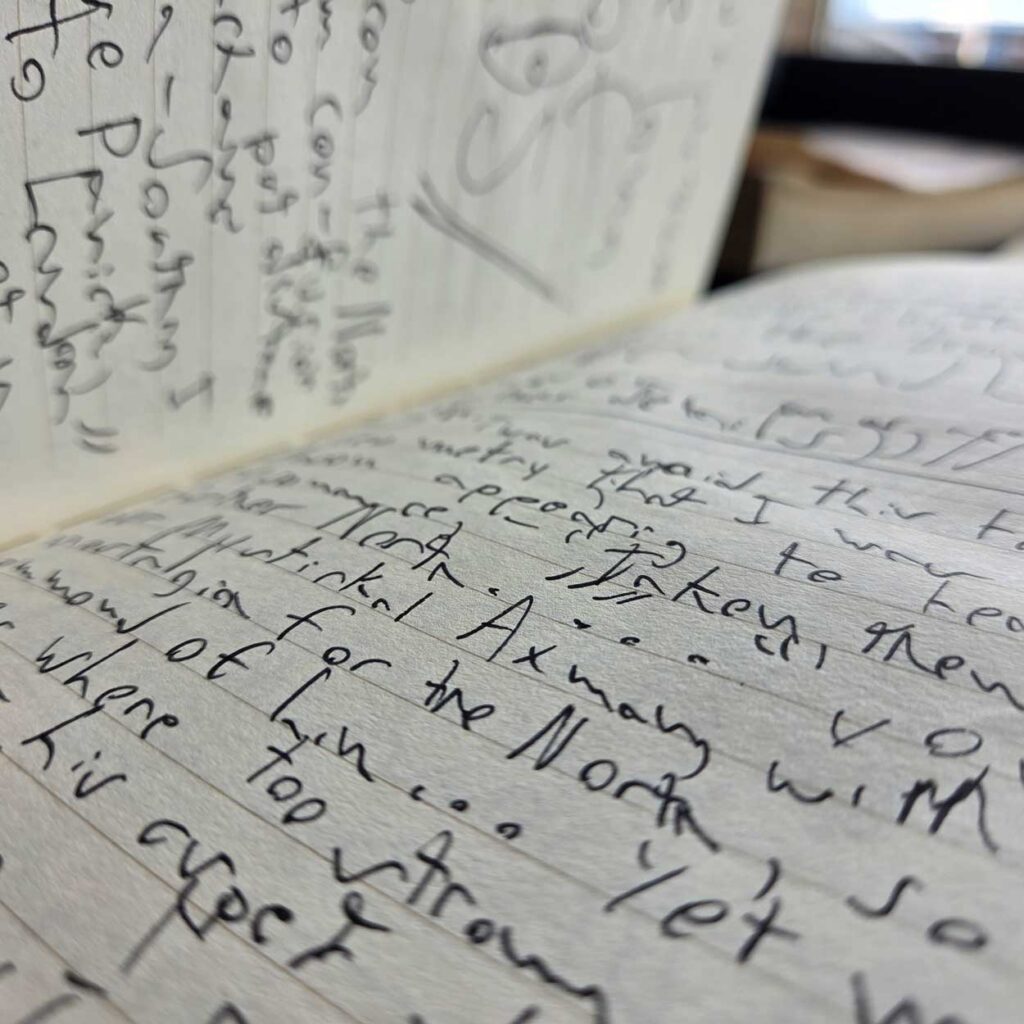
Like any good Postmodernist art piece, there is no 1 singular thing ( or name ) for this piece. You could say it is my copy of the book itself ( broken into 4 pieces from excessive use and interpretation ). You could say that it is my note book ( filled from cover to cover in mad scribbles written over a year of in-depth reading on my BART commute ). But, what I think is the most singular expression of this endeavor are these interactive maps you will find below.
Sadly, the map for page 0 – 257 has been lost to time and a lot of the referred URLs no longer work. But, you could even say that these unintended aspects of the piece simply highlight the point behind my piece: nothing that is filtered through a human lens can ever be “true” ( and – as we are human – we can never create something truly “true” ).
In these maps you will find at least 1 year of dedicated work ( not considering the 3 or 4 times I read this book before my final in-depth read ) and my hope is that as you click through reference after reference, quote after quote, and pin after pin you will start to get a clear picture of their voyage and the way to Pynchon has recreated it. Then, I hope there comes a tipping point; a point where you read 1 note too many and you start to realize those fractures in the story. I hope that little by little the “truth” of the story ( both the “factual” and “fictional” story ) starts to breakdown to the point where you are not quite sure which is which.