I am a little sad that I have not come across the original Spanish version of The Unworthy by Agustina Bazterrica, but I am so happy to have read this book. My first experience with Bazterrica was her breakthrough novel, Tender is the Flesh ( original title: Cadáver Exquisito [ which I personally prefer as it translates to either Exquisite Cadaver or { the even more metal } Delicious Cadaver ] ) and there are as many similarities as there differences between these 2 works. Both books have the amazing ability to throw you into a world that is both familiar and wholly absurd. We are given some societal conceits that should be so absurd, so perverse, so outlandish that they should be utterly unbelievable, but the way Bazterrica writes her characters makes you suspend your disbelief so quickly that the “reality” – no matter how absurd – feels totally real. Furthermore, though I can see how some people might think that these disturbing worlds Bazterrica creates are nothing more than shock-machines, I do feel that her work is taking real human and societal failures, perversions, and atrocities and externalizing them through the wild conceits in her books.
Where the books differ is in the humanity in their telling. I adore Tender is the Flesh, but as you read it is very clear that there is an inhuman disconnect in the main character we are following and the horrors of the book itself. The Unworthy is wholly different in this respect. The Unwholly is suffused by an ardent humanity from the first page. We see a person that has not lost connection to their human emotions, but has had those human impulses perverted by their unimaginable conditions.
I do not want to give any spoilers for this book in case anyone wants to read it ( this is the type of book where you need to feel the entire journey so that the moments that are meant to hit hit you without mercy [ I was literally weeping in public by the end of this book ] ), but here are some structural notes that I think will draw a lot of people to this novel:
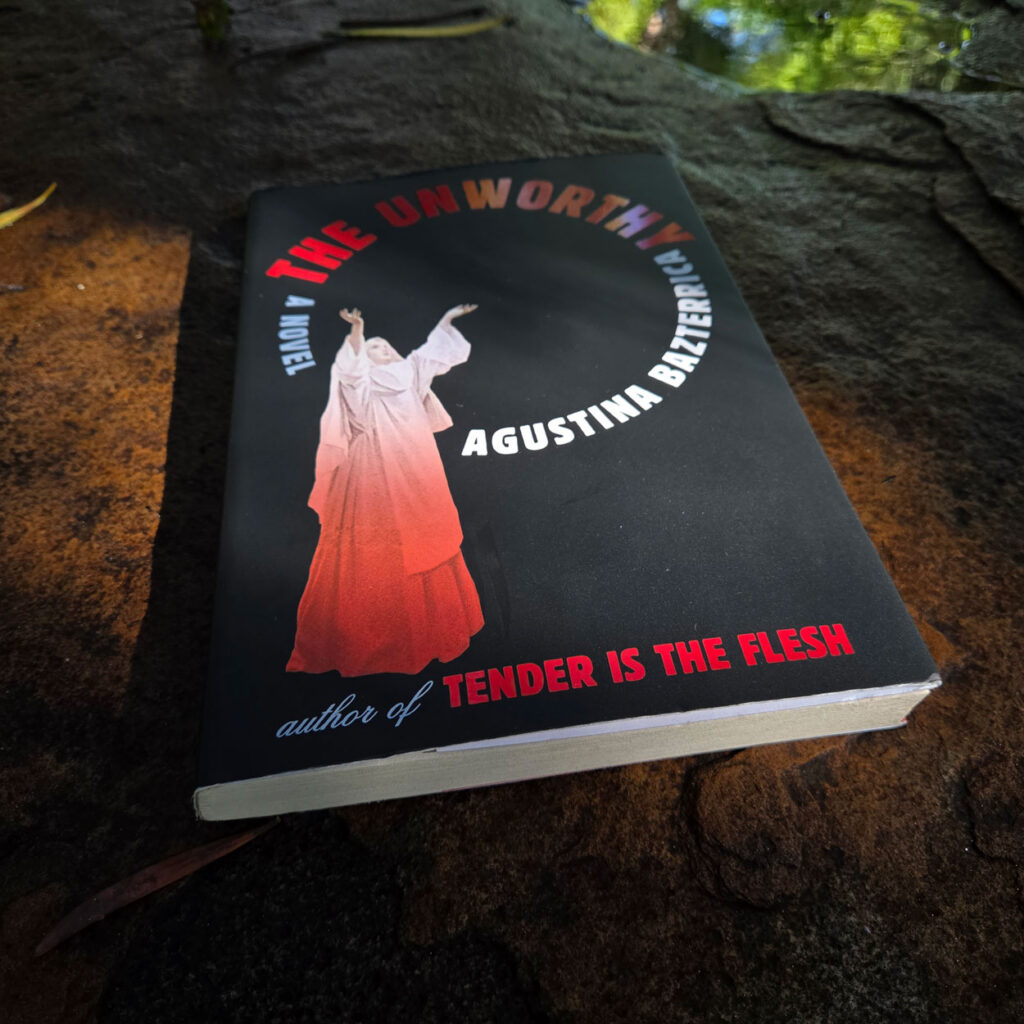
The central concept is that what you are reading is the illicit journal kept by a young woman surviving the post-apocalyptic world within the walls of the convent of the Sacred Sisterhood. This creates a wonderfully disjointed narrative that allows for the slow realization of exactly the type of world that you have been thrown into. As she writes her secret journal thoughts spiral out into mad deviations, her writing gets interrupted at crucial points in the story, you can see her internal struggles being revealed not just in her wording, but in the structure of her writing itself. It is a wonderfully inventive way to tell a story that speaks so much about the unknowability of reality, the selfish distortions of those in power, and the distrust in any type of metanarrative. That in itself should drive you to want to read this book, but once you actually start to read it you will find more light, more darkness, more humanity, and more hatred than you could ever imagine.
BEWARE, spoilers ahead:
Please don’t read any further if you don’t want to be spoiled! I fucking adore this book. I could talk about it from so many angles for so long, but what I want to highlight is how brilliantly Bazterrica uses the actual structure of the novel to illustrate the internal struggle of our main character, which in turn illustrates the internal tension in so many of the society level narratives we tell ourselves and base our thinking on.
From front to back, the book deals with uncertainty, both within ourselves and with the world around us. We are put in the mind of a character that both does not remember her life before the convent of the Sacred Sisterhood and does not allow herself to live freely due to the religious paradigm she is living under. At the same time, we are dealing with a character whose beliefs are wholly defined by those that ostensibly take care of her even when the reality they present is at odds with the reality that she can see with her own eyes. AND ON TOP OF THAT, she is a character that is never sure she even trusts her own eyes lest they be muddied by the waters of the River of Madness. Even the words we read live in that flow of uncertainty as even our narrator does not trust herself.
What this creates is a wonderful cacophony wherein “objectivity” itself becomes a thing that lives within your perspective, rather than in the world. We live with this character as she struggles against all of these opposing forces to the point that she unravels. But, in that unraveling, she finds a truth greater than that told to her by the religion of the Sacred Sisterhood. In the wolfish voice of the deer-like person she finds in the woods she finds her true truth and it supersedes anything that has come before or could ever come after. A truth that makes her see what she was, what she had become, and the only way to atone for what she has done.
When she sacrifices herself in the hollow of that rotten tree in the woods, she – and we – know that her sacrifice is likely futile. The Superior Sister will likely either run past the tree to find the fallen Enlightened or she will stop for only a short period of time to punish The Irreverent ( she deserves that proud moniker after everything she did not only for her Deer with the Wolfish Voice but for The Chosen Mutilated, for The Enlightened Molested, The UnWorthy and The Servants Workers ) and she will continue to try to destroy those that dare live. But, that is beside the point.
In many ways, I believe that a big part of what is being expressed in this book is what it means to make a stand against insurmountable odds when we know what is right.
Our main character has – obviously – suffered such horrible things in order to survive, but what she regrets more than anything was sacrificing the person she loved in order to survive. Throughout the narrative it becomes clear that out of everything, this is the thing that eats her from the inside out, the one thing she regrets as a price for her survival. But what else could she have done? It is a fair question, one that responds that “you did what you had to do” with such ease that it becomes easy to ignore that other voice in the back of your mind that is trying to make you realize what you actually did.
Her ultimate surrender in that hollow stump that was the minute of oasis of her freedom is perfect. It is the ultimate example of surrendering to something you know is right even as you are sure that what you are doing is futile. It is the ultimate triumph of principal over pragmatism. Again, it is fucking beautiful.
Even with this spoiler-filled description I know that I am in no way doing justice to the brilliance of the final downfall that Bazterrica crafted. I cannot in any way make you understand how powerfully this ending hits you unless you have read the book. The way your realization of the true extent of what her final action means builds page after page is truly breathtaking. As the last few sentences slip through your consciousness you become aware of an emotional truth so vast and human that it obliterates all reality in its irrevocable wake.